With the advancement of Industry 4.0, the global manufacturing industry is undergoing an unprecedented digital and intelligent transformation. As the core equipment of automation, traditional PLC (Programmable Logic Controller) used to mainly undertake sequential control and on-site execution tasks. However, in the smart factory environment, the role of PLC is undergoing a qualitative change: it is not only an executor, but also a data collection node, an edge computing platform, and an AI algorithm interface. Nevertheless, under the long-term operation of existing control systems, how to realize data-driven decision-making, predictive maintenance, and real-time process optimization while maintaining stability has become a core challenge for industrial enterprises. This paper will comprehensively explain the new path of smart factory construction from the perspectives of PLC evolution, in-depth integration of IIoT, application of AI in industrial automation, and architecture design and implementation strategies.
The Evolution of PLC in Smart Manufacturing
From Traditional Sequential Control to Networked Intelligent Control
Early PLCs were mainly used for discrete control and sequential logic processing, with single functions and limited interfaces with external systems. With the growth of industrial digitalization needs, modern PLCs have the characteristics of networking, modularization and scalability, and can achieve seamless connection with sensors, actuators and enterprise management systems (MES/ERP). The key points of the evolution of modern PLCs are reflected in the enhanced real-time data collection capability, which can collect multi-dimensional industrial data such as temperature, pressure, vibration and flow rate. At the same time, it serves as an edge computing node with built-in data preprocessing functions, which can filter, aggregate and conduct preliminary analysis on collected data to reduce the pressure on cloud computing. It also has an AI algorithm interface, which can transmit key data to AI models through OPC UA, REST API or MQTT protocols to realize predictive analysis and adaptive control. For example, in an auto parts production line, PLC realizes real-time monitoring by collecting vibration and temperature data of each machine tool, and provides a data foundation for subsequent AI process optimization. Through this method, production efficiency is improved by about 12% and equipment failure rate is reduced by about 20%.
In-depth Integration of IIoT and PLC
Definition and Role of IIoT Platform
Industrial Internet of Things (IIoT) is the data hub of smart factories, responsible for equipment interconnection, data standardization, remote monitoring and analysis. The IIoT platform can connect PLCs, sensors, actuators and gateways in a unified network to realize visual and intelligent analysis of data.
Communication Solutions Between PLC and IIoT
The data interaction between PLC and IIoT platform relies on efficient and reliable communication protocols. Among them, Modbus TCP/IP is suitable for fast data collection of on-site equipment with low latency and support for multi-node connection; EtherNet/IP provides real-time control capability and supports large-scale equipment networking; OPC UA, as an industrial standard protocol, can ensure data interoperability and security of cross-manufacturer equipment.
Data Management and Visualization
Through the IIoT platform, PLC data can be managed in the cloud or edge servers. On the one hand, production personnel can check key process parameters at any time through real-time dashboards; on the other hand, statistical analysis of equipment status is carried out through historical trend analysis to support predictive maintenance and process optimization.
Application of AI in Industrial Automation
Overview of AI Technology
In modern smart factories, AI technologies mainly include machine learning, deep learning and predictive algorithms, which can be used for pattern recognition, anomaly detection and optimal decision-making.
Application in PLC+IIoT Architecture
The application of AI in the PLC+IIoT architecture is reflected in many aspects. Predictive maintenance can predict equipment failures by analyzing data such as vibration, temperature and load. According to Gartner data, the application of predictive maintenance can reduce unplanned downtime by 20%-30% and extend equipment life by 10%-15%. In terms of process optimization, AI can real-time analyze production parameters such as temperature, pressure and speed to realize automatic adjustment, improving product consistency and production capacity. A chemical enterprise adjusted the temperature of the reactor through AI, realizing an 8% increase in raw material utilization rate and a 5% increase in production capacity. In terms of energy consumption optimization, AI analyzes energy consumption patterns, optimizes equipment operation strategies and reduces operating costs, with an energy saving rate of 10%-15%, which is particularly significant in high-energy-consuming factories. At the same time, the AI model feeds back the analysis results to the PLC, realizing adaptive control and intelligent decision-making closed loop, and promoting the overall optimization of the factory.
Architecture Design and Implementation Strategy
Schematic Diagram of Hierarchical Architecture
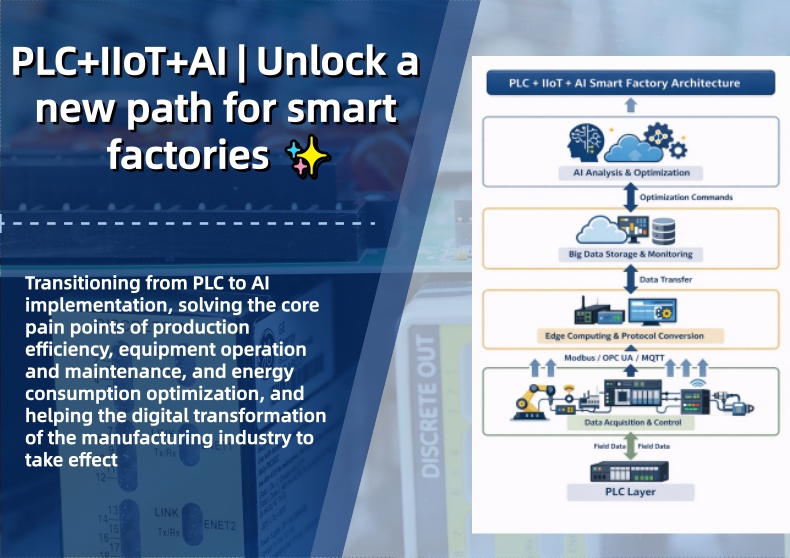
The PLC+IIoT+AI architecture of smart factories is usually divided into four layers: the PLC layer responsible for on-site control and data collection, the edge gateway layer undertaking local data preprocessing, edge computing and protocol conversion, the cloud platform layer responsible for big data storage and analysis, and the AI analysis layer carrying out machine learning model training, predictive analysis and optimal decision-making output.
Implementation Notes
Various issues need to be paid attention to in the implementation of the smart factory architecture. It is necessary to maintain production continuity and system security by running old and new systems in parallel to avoid downtime caused by upgrades; focus on network and data security, adopt OT network isolation, end-to-end encryption and access control to ensure data security; implement a phased migration strategy, deploy PLC+IIoT+AI in stages, verify on a single production line first, and then promote it to the entire factory. A food processing enterprise has achieved the initial construction goal of a smart factory through the construction of this architecture, with a 15% increase in production capacity, a 30% reduction in failure downtime, and a 12% energy saving rate.
Challenges and Solutions
The construction of smart factories faces challenges such as large data volume and high real-time requirements, insufficient compatibility between multi-manufacturer PLCs and IIoT platforms, AI model and industrial control security, and system upgrade risks. The corresponding solutions are to introduce edge computing and high-efficiency gateways to realize local data processing to reduce latency, adopt standardized communication protocols (OPC UA, Modbus TCP/IP) to ensure cross-equipment interoperability, verify AI models in a simulation environment to ensure their safety and stability for on-site control, and avoid production interruption through phased deployment strategies and parallel operation of old and new systems.


Penafian:
Nordwel menjual bahagian automasi industri, termasuk produk baharu dan produk yang dihentikan, dan membeli produk yang ditampilkan melalui saluran bebas. Nordwel bukan pengedar sah, pengedar atau wakil produk yang ditampilkan di laman web ini. Semua nama produk / imej produk, tanda dagangan, jenama dan logo yang digunakan di laman web ini adalah hak milik pemilik masing-masing. Penerangan, perihalan atau penjualan produk dengan nama, gambar, tanda dagangan, jenama dan logo ini adalah untuk tujuan pengenalan sahaja dan tidak membayangkan sebarang perkaitan atau kebenaran dengan mana-mana pemegang hak.